

No. With dark films, visibility is possible from the side with less light. For example, during the day, you cannot see into the room, but at night, when the light inside the room is brighter than outside, you cannot see out. There are some films that allow you to see out in the evening, but no mirror film provides 100% privacy at all times. The best solution for a window that guarantees 100% privacy 24/7 is a frosted film (or opaque film), but with that, you can neither see in nor out.
.
You must measure the surface area where the film will actually be installed. For example, for a window, it is important to measure only the glass surface, not the size of the window opening, and not the glass with the frames, but only the actual glass surface area. The measurement does not have to be extremely precise; measuring with a ±1 cm accuracy is sufficient! The material will be cut out beforehand with an allowance.
In case the window frame has dividing bars (glazing bars) forming a grid, you must measure all the squares separately, as we do not remove the bars!!
The measurements does not have to be extremely precisemeasuring with a ±1 cm accuracy is sufficient!
UV film and sun protection film are both types of window film , but their functions and properties are different.
UV-film
- UV film is a film specifically designed to block Ultraviolet radiation (UV rays)
- It is typically used to cover windows, glass, or other transparent surfaces to protect people and objects inside the rooms from the harmful effects of direct UV radiation.
- UV film helps to a small extent in reducing the fading of furniture, carpets, and other items, and it protects the skin from sunburn.
- UV film is completely transparent and virtually indistinguishable to the eye.
Sun Protection Film (Solar Control Film):
- Sun protection film is designed to reduce the amount of solar radiation that enters the building.
- It contains various layers and additives that decrease the transmission of solar energy and heat entry.
- Sun protection film helps to lower the indoor temperature, thereby reducing cooling costs and the intensity of natural light.
While both films offer protection from the sun, their primary purposes are different. UV film focuses mainly on UV radiation protection, whereas the goal of sun protection film is to reduce the overall impact of solar radiation, including limiting heat and light. As a rule, the client's problem is heat, i.e., Infrared (IR) radiation, not UV
The quality primarily depends on how and how often the surfaces have been maintained, as well as the condition and age of the window frames. If a window is located on a busy traffic artery with constant dust, and the windows are washed only a couple of times a year at best, we cannot clean that window before film installation as thoroughly as, for example, the windows of a new development located in a quiet forest grove. age. If a window is located on a busy highway with constant dust and is washed at best a couple of times a year, we will not be able to get the window as clean as a new development in a quiet wooded area, for example, before installing the film.
For exterior film and windows with wooden frames, a a 100% clean job is nearly impossible. Some contamination will inevitably remain under the film, despite the fact that we wash the windows and frames up to three times , if necessary, before film installation. In addition, wind and flying dust are interfering factors when installing exterior film.
Every installer's goal is to achieve a "factory tint" finish but inevitably something will remain underneath unless the work is performed in a 100% sterile indoor environment.
We use the "International Window Film Requirements" as the standard for quality. Quality assessment is performed from the inside of the room and from no closer than 2 meters (approximately 6.5 feet) from the window.
Source:
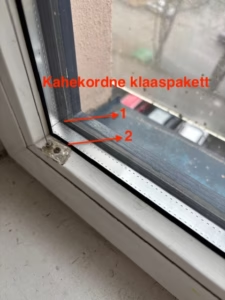
If you can see two metal spacers (or strips), you have a triple-glazed unit (three panes of glass). If you see one spacer, you have a double-glazed unit (two panes of glass).
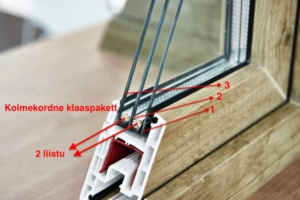
The image above shows a triple-glazed unit. The one below shows a double-glazed unit.
When dealing with filmed surfaces, it is important to remember that film is still plastic and is much easier to scratch than tempered glass.
If the window is very dirty, it is better to first rinse off the major dirt with loose water (running water), and only after that wash it normally, just like an regular window.
DO NOT USE WINDOW CLEANERS THAT CONTAIN AMMONIA OR ABRASIVES!
Most interior films come with a lifetime manufacturer's warranty. Exterior films, however, depending on whether they are installed on horizontal surfaces (10 years) or vertical surfaces (5 years). However, reality shows that films produced in the USA have lasted longer than promised.
However, reality shows that films produced in the USA have lasted longer than promised.
As a rule, you should consider replacing the film if there is mechanical damage (scratches, scrapes, etc.), if the film is maintained incorrectly, or if the film is crumbling or has turned opaque/matt.
We provide a 2-year warranty on installation.
Generally, if the film's edges have not started to peel or the film has not started to detach within two years, the film will successfully last until the end of its lifespan.
The film is transported in rolls and is covered with a special thin silicone layer which makes the film layer slicker and protects it from scratches during installation. When the film is installed, this layer partially dissolves, giving the impression that the installer has carelessly cleaned the window after finishing the work.
The traces of this dissolved silicone layer will naturally disappear in the outdoor environment after the first rainfalls, and this problem will not occur again when the window is washed in the future.
- For the installation of exterior film, the outdoor temperature must be at least +5 throughout the day. The warmer the weather, the faster the film will dry.
- The weather must be suitable for installation: the wind should not be strong, and there should be no very intense rainfall.
The optimal drying time is 30 days, depending on the weather conditions. If the weather is warm and sunny, it will dry faster; if it is humid, rainy, cool, and with little sun, it will take longer.
Bubbles/Water Pockets Appear After Installation.
The film is installed using soapy water, and it is impossible to remove all the water used for installation meaning these are not air bubbles but water pockets.Water pockets usually appear some time after installation or on the following day. This is soapy water that accumulates on the glass and resembles a bubble. The water will dry out by itself, and under no circumstances should you try to chase these "bubbles," as this can leave permanent marks. Patience and warm weather/sun are needed.
The same applies to the haziness; it is a layer of soapy water that naturally has a grayish tint.
After the film is completely laminated (fully dried and adhered), the water pockets and haziness will disappear.
Window film installation is a specialized skill that can only be acquired through practice. You can install the film yourself, but just like in any field, there are specific tricks and techniques here to achieve the best quality, which guarantees long-term satisfaction.
Some customers believe that only initiative, film, and soapy water are needed for tinting, but unfortunately, they are not satisfied with the result of their work. And if you later contact an installer, the professional installation will also include the removal of the old film before the new film can be applied.
Removing the film generally consists of two stages:
- Film Removal: This is easy and fast, provided that quality material was used. Some films come off by crumbling into tiny pieces.
- Adhesive Removal: This requires more time and attention. As a rule, we remove films without using solvents in order to protect surrounding surfaces and cause as little damage as possible.
Order both the removal and the installation from us and receive a discount!
Depend on mainly from two factors:
- The thermal insulation and insulation of the rooms. Even the darkest film will not improve a poorly insulated house. The film successfully improves only the heat coming through the glass. The larger the ratio of windows to the room size, the more effective the film is. However, if the windows are average and the house's insulation is poor, heat will still enter the room, either through the walls or the roof.
- The properties of the film itself. The rule of thumb is that if the problem is excessive heat, you should always install a darker film rather than a lighter one. The darker the tint, the more effective the film is.
Most cars are equipped with air conditioning and have tempered glass, which makes black tint film an excellent choice for privacy and aesthetics. However, black glass absorbs more sunlight than clear glass, creating a radiator effect - the car windows heat up from the inside. Since a car’s interior volume is small and cooling is much more efficient and affordable than in buildings, this drawback is easily compensated for. Additionally, mirror films are not legally permitted on car windows.
When applied to building glass, however, black film can have the opposite effect — the glass heats up from the inside, causing indoor temperatures to rise even higher than before tinting. The only way to counter this is through strong cooling and good ventilation systems— both of which are usually more expensive solutions than simply installing mirror film designed for architectural use. The purpose of window films on buildings is primarily to reduce the cooling load on HVAC systems.Excessive heat can also cause thermal expansion, which may lead to glass cracking or clouding if the seals fail to withstand the pressure. There are exterior black films available, but their efficiency is lower compared to mirror films, which remain the most effective option for buildings. Feel free to contact us for more detailed information!
Note: Glass cracking can also occur with improperly installed thermal blinds if insufficient ventilation space is left between the blind and the glass.
Thermal breakage is a very rare phenomenon that can occur with any type of window covering — whether it’s curtains, blinds, or film. At KilePunkt, we use only solar protection films that are compatible with each specific type of glass — exterior films where they’re most suitable, and interior films only when the glass allows it.
Although the risk is minimal, it cannot be completely ruled out, and we cannot take responsibility for thermally fractured glass, as this depends on the properties of the glass and structural factors. The good news is that in 99% of cases, nothing happens — the windows keep serving their purpose for many years!
Blinds and shutters — like those commonly used in southern countries — are effective only when installed on the exterior of the building.However, this is a costly solution, not very common, and it also requires automation and wiring.
If you install them inside the room, there will be a When installed inside the room, these coverings create aradiator effect — the blinds or curtains heat up, providing little to no cooling benefit. They also block the view and require manual operation.
Window film, on the other hand, is the most convenient and cost-effective “install and forget” solution!